Home › Facility › Sports Wind Tunnel
Sports Wind Tunnel
Summary
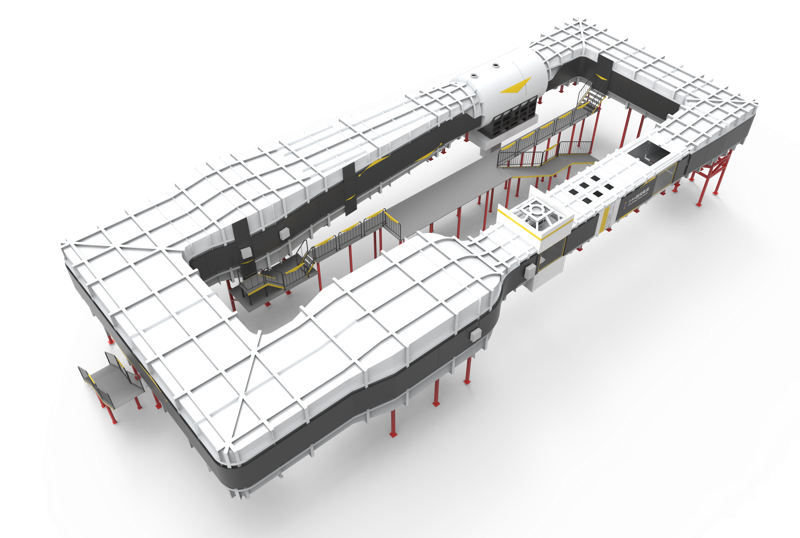
The low-speed wind tunnel was developed after a two-year redevelopment project. The facility is designed with two aerodynamic test areas and a further test section dedicated to civil-engineering testing, and is the principal instrument behind the Laboratory's sports wind tunnel research.
Technical details
- Test section dimensions: 14 m (L) × 2.5 m (W) × 2 m (H)
- Turbulence intensity: < 0.12%
- Flow uniformity: < 0.4%
- Flow angularity: < 0.5°
- Working temperature: heat exchanger unit sets working temperature to about 24 °C
- Test speeds: 2.5 m/s to 40 m/s
- Background noise: LAeq < 58 dB at 5 m/s
The background-noise figure is the reason the tunnel is usable for sport: at walking and running speeds a conventional tunnel is loud enough that a participant cannot communicate with the test team during a run.
Aerodynamic test section
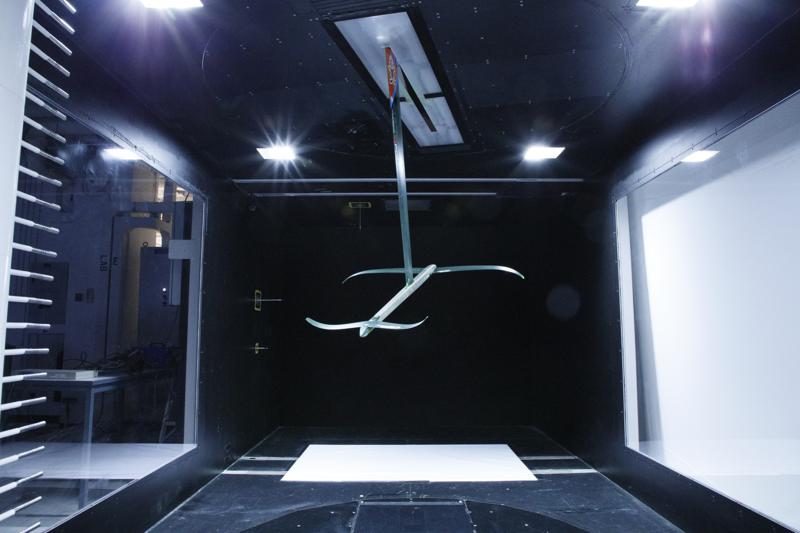
The aerodynamic test section consists of two turntable units, each capable of rotating 360 degrees. The overhead turntable can additionally suspend a sting mount with a variable inclination-angle controller, which enables suspended models to be tested at a range of pitch and yaw angles.
This test section is used for:
- Performance-sports engineering: athletes, bicycles, helmets, wheels, apparel and equipment
- Unmanned aerial vehicle testing
- General aerospace research and development testing
Boundary-layer test section
The boundary-layer test section is located towards the downstream end of the 14 m long test section. It consists of a base turntable, capable of rotating 360 degrees, and is surrounded by two large glass panels that provide optical access.
This test section is used for:
- Boundary-layer research and flow visualisation
- Civil engineering aerodynamic testing (buildings, façades, and similar)